A hillside lot may offer stunning views, but unstable ground can turn a dream purchase into a financial disaster. Learn how geology, drainage, and slope conditions affect land safety—and why buyers should screen these risks before paying a deposit.
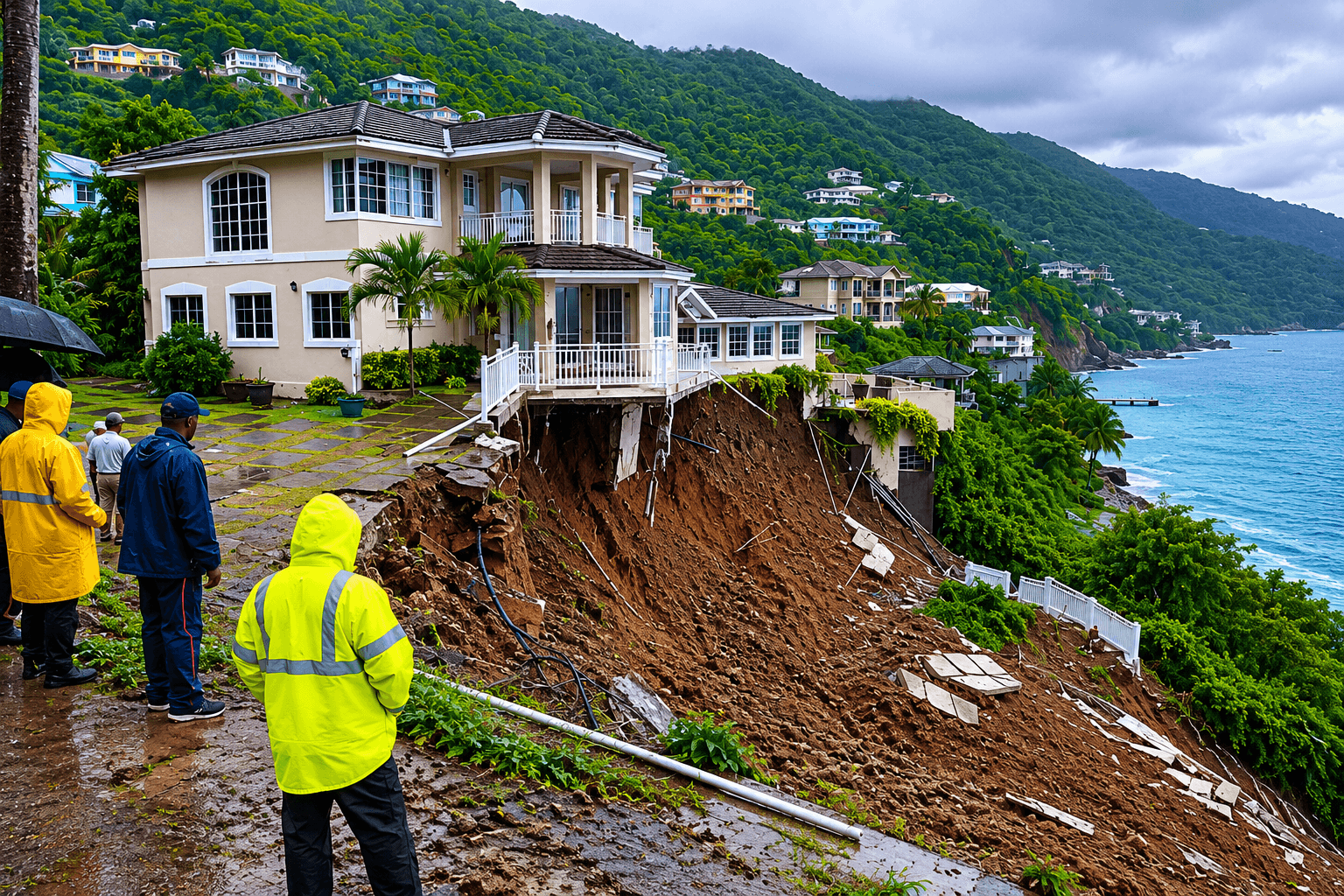
Why land buyers should screen slope, drainage and ground risk before paying a deposit
A hillside parcel can be attractive because it offers views, privacy and cooler air. But the same slope that makes a property desirable can also hide the most expensive risks: ground movement, road failure, drainage problems, foundation instability and loss of access after heavy rain.
For buyers in the diaspora, the danger is that many of these risks are not obvious from a listing photo, realtor description or clean title search.
Why geology matters before a deposit is paid
Geology decides whether a hillside can safely carry a house, road or retaining wall because rock and soil layers control strength, drainage and failure planes.
A slope built on fractured rock, weathered shale, old landslide debris, clay-rich soil or poorly drained colluvium can look stable in dry weather but weaken quickly during heavy rain. Water raises pore pressure, reduces friction and can turn hidden bedding planes or soil-rock contacts into sliding surfaces.
That means a "great view" can also hide expensive risks:
- Slope stabilization costs
- Access-road failure
- Site redesign
- Insurance limitations
- Loss of use
- Unexpected engineering expenses
What the ground is telling you
A landslide is the downslope movement of rock, debris or earth under gravity.
The cause is rarely one factor. It is usually a combination of:
The geology matters because different materials fail in different ways.
For a buyer, these technical details translate into ordinary financial consequences.
A parcel may require:
In the worst cases, the land may simply be unsuitable for the intended use.
These are costs that should influence the purchase decision before the deposit is paid, not after the buyer has lost leverage.
Jamaica example: Shooter's Hill, St. Andrew
The Shooter's Hill tragedy in rural St. Andrew shows why land-risk screening is not merely academic.
In October 2020, heavy rains caused land slippage that collapsed the house occupied by Romeo Leachman and his daughter Saneeka. Jamaica Information Service reported that both died when the house collapsed due to land slippage associated with the heavy rains.
Officials later visited the community, and the Local Government Minister indicated that many houses in the area might ultimately require relocation rather than rehabilitation because of the severity of the land-slippage conditions.
The landslide swept away the home while Jamaica Fire Brigade personnel and residents searched through rubble, mud and rock.
The image included in this blog illustrates the type of slope failure and emergency response conditions that can follow when homes are built on unstable hillside ground.
The important planning lesson is that a "buildable" parcel should not be judged by ownership documents alone.
Buyers also need to know whether the site:
Following the 2020 rainfall events, Jamaica's Prime Minister warned that the country should consider no-build zones in areas vulnerable to severe flooding and landslides, noting that homes built on denuded hillsides and marginal lands remain particularly exposed during significant rainfall events.
How LandSentry could have helped before commitment
LandSentry would not replace a geotechnical engineer, surveyor or attorney.
Its value comes earlier.
It provides buyers with a structured warning system before money is committed.
A LIFT™ screening begins with:
It then combines available information such as:
The result is a first-look risk picture.
For a hillside lot similar to the Shooter's Hill context, the LIFT™ workflow asks:
When CLEAR™ becomes necessary
A CLEAR™ review goes further.
It may incorporate:
That combination helps transform vague concerns into practical decisions.
Buyers can then choose to:
The return on diligence
The return on a LandSentry report is not only measured by avoiding a bad parcel.
It is also measured by reducing uncertainty and improving decision-making speed.
A buyer who identifies slope or access problems early can:
For diaspora buyers, the time savings can be just as valuable as the financial savings.
You may be evaluating property from New York, Toronto, London or Miami while relying on photos, listing descriptions and someone else's local opinion.
LandSentry helps provide a clearer picture:
Before you pay a deposit
Before you pay a deposit on hillside, rural or view land, send LandSentry:
Start with LIFT™ for a fast desktop risk screen.
Move to CLEAR™ when slope, access, drainage, survey, field or permitting questions must be resolved before commitment.
The cost of diligence is almost always less than the cost of discovering hidden ground risks after you've already committed.